Description
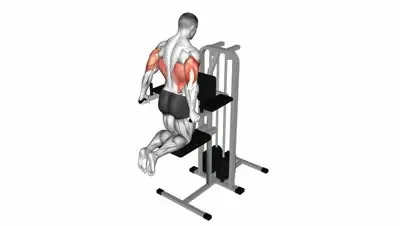
The bench dip is a bodyweight triceps exercise performed by lowering and pressing your body between two elevated surfaces — typically a bench behind you and either the floor or another bench in front for your feet — using only your own body weight as resistance. Placing your hands behind you on a bench and bending your elbows to lower your hips toward the floor trains the triceps through a deep stretch that's difficult to replicate with a barbell or cable exercise, while also demanding some shoulder stability to control the movement. Because it needs no equipment beyond a sturdy bench or chair, it's one of the most accessible triceps exercises available for training anywhere.
How to perform
- Set your hand position Sit on the edge of a sturdy bench with your hands placed just outside your hips, fingers pointing forward or slightly inward.
- Walk your feet forward Slide your hips forward off the bench and walk your feet out until your legs are extended, either with knees bent or straight depending on difficulty.
- Support your weight on your hands Straighten your arms to support your body weight with your hands on the bench, keeping your shoulders down away from your ears.
- Lower your body by bending the elbows Bend your elbows to lower your hips straight down toward the floor, keeping your elbows pointed back rather than flaring out to the sides.
- Stop at a comfortable depth Lower until your upper arms are roughly parallel to the floor or as far as your shoulders comfortably allow, without any pinching sensation.
- Press back up to full extension Push through your hands to straighten your arms and return to the starting position, keeping your shoulders set throughout.
Tips
- Keep your elbows pointing back rather than flaring out to the sides — flared elbows increase shoulder strain and reduce triceps involvement.
- Bend your knees and keep your feet close to the bench to make the exercise easier, or extend your legs straight out to increase the bodyweight load.
- Stop your descent well before you feel any pinching or discomfort in the front of your shoulder — depth should feel challenging, not painful.
- Keep your hips close to the bench throughout the movement rather than drifting forward, which keeps the resistance focused on your triceps.
Common mistakes
- Descending too deep, especially with tight or unstable shoulders — going lower than your shoulder mobility allows is the most common cause of shoulder discomfort with this exercise.
- Flaring the elbows out to the sides — this shifts stress toward the shoulder joint and reduces the triceps-focused benefit of the movement.
- Shrugging the shoulders up toward the ears — this reduces stability and can contribute to shoulder impingement over repeated sets; keep shoulders pulled down.
- Using momentum to bounce out of the bottom position — bouncing skips the controlled eccentric tension and increases joint stress without added muscle benefit.
Recommended sets & reps
| Sets | Reps | RIR | |
|---|---|---|---|
| Strength | 3 | 8–12 | 1–2 |
| Hypertrophy | 2–3 | 10–15 | 1–2 |
| Endurance | 2–3 | 15–20 | 2–3 |
| Power | 2–3 | 8–10 | 1–2 |
These ranges are working sets only — add 1–2 progressive warm-up sets before each working set. As a bodyweight exercise, progress by increasing depth, adding a weighted vest, or elevating your feet on a second bench before adding more reps. Anyone with existing shoulder discomfort should limit depth or choose a different triceps exercise (Schoenfeld 2017, Pelland 2025).
Benefits
Trains the triceps through a deep stretch position that's difficult to replicate with barbell or cable pushdown variations, adding a valuable range of motion to a well-rounded triceps program. Requires no equipment beyond a sturdy bench, chair or box, making it one of the most accessible triceps exercises for home workouts or travel. Builds functional pressing strength that carries over to dips, close-grip bench press and other compound pressing movements that rely heavily on the triceps for lockout. A simple, scalable exercise that can be made easier by bending the knees or harder by extending the legs or elevating the feet on a second surface.
Frequently asked questions
Why do my shoulders hurt during bench dips?
This is a common issue and usually comes from descending too deep for your current shoulder mobility. Reduce your range of motion, stop the descent higher, or switch to a triceps pushdown or overhead extension if shoulder discomfort persists.
How can I make bench dips harder?
Extend your legs fully straight instead of bending your knees, elevate your feet on a second bench, or add weight across your lap using a weighted plate once bodyweight reps become easy.
Bench dips vs triceps pushdowns — which is better?
Pushdowns allow more controlled, adjustable loading and are generally gentler on the shoulders. Bench dips are more accessible without equipment and train a deeper stretch position, but require good shoulder mobility to perform safely.
Should bench dips be done with bent or straight legs?
Bent knees with feet close to the bench make the exercise easier by reducing the bodyweight load on your arms; straight legs increase the difficulty. Choose based on your current strength and progress toward straight legs over time.
Educational guidance only — not a substitute for in-person coaching. Train within your ability and use a spotter for heavy attempts.