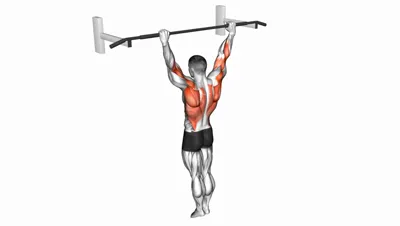
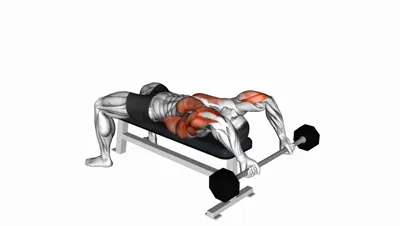
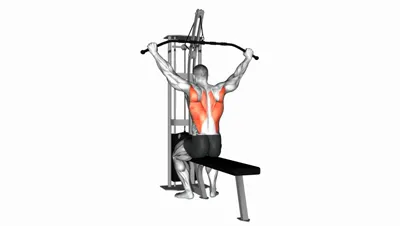
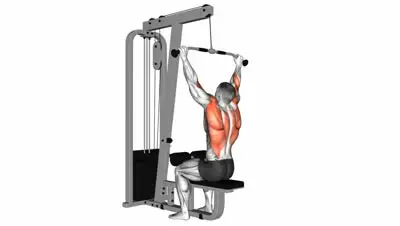
Description
The cable straight arm pulldown isolates the lats through pure shoulder extension, pulling a cable bar down from overhead to your thighs while keeping your elbows locked in a fixed, slight bend rather than flexing them like a row. Because the arms stay straight throughout, this movement removes the biceps almost entirely from the equation, making it one of the most direct ways to isolate the lats without any assistance from your pulling arm muscles. It's a favorite lat-activation drill before heavier pulldowns or rows and a standalone finisher for building lat width and definition.
How to perform
- Set the cable to overhead height Attach a straight or slightly angled bar to a high cable pulley and stand facing the machine, gripping the bar with a shoulder-width overhand grip.
- Set your stance and lean Step back slightly and lean your torso forward a few degrees from the hips, keeping a soft bend in your knees and a flat back.
- Fix your elbow angle Set a slight, fixed bend in your elbows and keep that exact angle locked throughout the entire set — your arms should not flex or extend.
- Pull the bar down to your thighs Keeping your arms straight, pull the bar down in an arc toward your thighs by driving your shoulders down and back, not by bending your elbows.
- Squeeze your lats at the bottom Pause for a moment with the bar at your thighs, feeling the contraction spread across your entire lat, then hold briefly.
- Return to the overhead start Let the bar rise back up under control to the starting position, resisting the cable's pull the entire way up.
Tips
- Keep your elbow angle completely fixed for the whole set — if your elbows bend more on the pull-down and straighten more on the return, you've turned this into a partial pushdown.
- Think about pulling with your shoulders and lats rather than your hands — focusing on driving your upper arms down keeps the biceps out of the movement.
- Use a lighter weight than you'd expect — because the lats work in isolation without help from the arms, this exercise requires far less load than a pulldown or row.
- Lean forward slightly from the hips rather than staying fully upright — a small forward lean helps align the pulling path with your lats' natural line of pull.
Common mistakes
- Bending the elbows during the pull — this recruits the triceps and turns the movement into a pushdown variation, removing the pure lat isolation that makes this exercise valuable.
- Using too much weight and swinging the torso — momentum from the hips takes tension off the lats and can strain the lower back; keep the movement slow and controlled.
- Pulling the bar too low, past your thighs — over-pulling with a shrugging motion at the bottom shifts stress to the shoulders instead of finishing cleanly at hip level.
- Letting the cable snap back on the return — releasing control on the way up wastes the eccentric portion of the lift, which is a key part of the growth stimulus.
Recommended sets & reps
| Sets | Reps | RIR | |
|---|---|---|---|
| Strength | 3 | 10–12 | 1–2 |
| Hypertrophy | 2–3 | 12–15 | 1–2 |
| Endurance | 2–3 | 15–20 | 2–3 |
| Power | 2–3 | 10–12 | 2–3 |
These ranges are working sets only — add 1–2 progressive warm-up sets before each working set. Pair with 2× per week frequency to reach ~10–20 weekly sets per muscle group, the volume range supported by current evidence (Schoenfeld 2017, Pelland 2025).
Benefits
Isolates the lats through shoulder extension alone, removing nearly all assistance from the biceps and making it one of the purest lat-specific exercises available. Works well as an activation drill before heavier pulldowns or rows, helping you feel the lats engage before adding load to a compound movement. Builds lat width and definition with minimal joint stress, since the light loads and controlled arc place little strain on the elbows or wrists compared to heavier pulling exercises. A useful finisher at the end of a back workout when your grip and biceps are already fatigued from rowing but your lats can still handle more targeted volume.
Frequently asked questions
Why does this feel so much lighter than a lat pulldown?
Because your arms stay straight and your biceps don't assist the pull, the lats work almost entirely alone. Expect to use significantly less weight than a standard lat pulldown at a comparable rep range.
Should I use this before or after other back exercises?
Many lifters use the straight arm pulldown as an activation exercise at the start of a back workout to feel the lats engage, then again as a finisher at the end once the biceps are fatigued from rowing.
Why do my triceps burn during this exercise?
If your elbows are bending and straightening during the movement instead of staying fixed, you've turned it into a pushdown that recruits the triceps. Lock your elbow angle in place and pull purely with your shoulders.
Rope attachment vs straight bar for straight arm pulldowns — does it matter?
Both work well. A rope attachment allows the hands to separate slightly at the bottom for an added squeeze, while a straight bar keeps the movement simple and symmetrical — either is a valid choice.
Educational guidance only — not a substitute for in-person coaching. Train within your ability and use a spotter for heavy attempts.