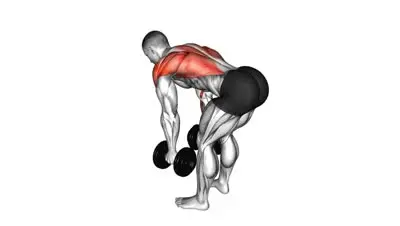
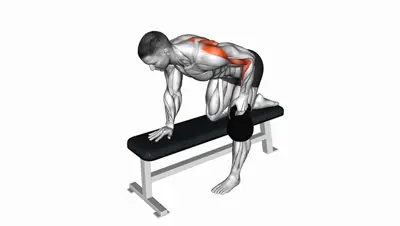
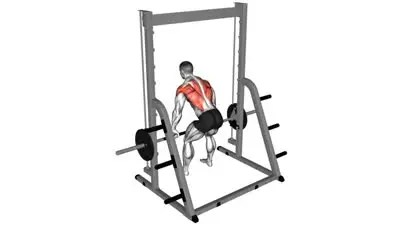
Description
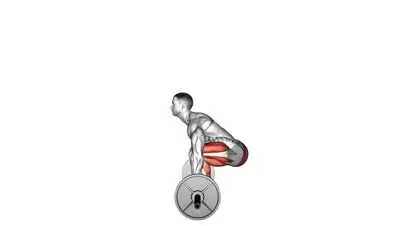
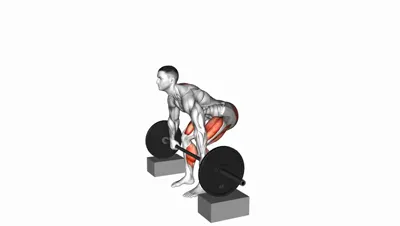
The barbell bent-over row is the foundational horizontal-pulling compound for back thickness, loading the lats, rhomboids, mid-traps and rear delts while the biceps assist as elbow flexors. Performed with a hip-hinged torso roughly parallel to the floor, it trains the entire back through a long range of motion against heavy free-weight load. As the primary horizontal-pull counterpart to the bench press, the bent-over row builds the dense, three-dimensional back that machines struggle to replicate, and demands real bracing strength from the spinal erectors to hold position under load.
How to perform
- Set your hinge position Stand with feet hip-width under a loaded barbell. Hinge at the hips and push your butt back until your torso is roughly parallel to the floor, keeping a flat, braced back and soft knees.
- Grip just outside your knees Take a double-overhand grip slightly wider than shoulder-width. Let the bar hang at arm's length over your mid-foot with the lats engaged and shoulders pulled back, not rounded forward.
- Brace before the pull Take a deep belly breath, brace your core hard, and fix your gaze a few feet ahead for a neutral neck. Your hips and shoulders should stay level throughout.
- Row to the lower ribs Pull the bar toward your lower ribs and upper abdomen by driving your elbows back and up — lead with the elbows, not the hands. Squeeze your shoulder blades together at the top.
- Lower under control Lower the bar to full arm extension under control, letting the lats stretch at the bottom without losing your braced torso. Do not let the bar drift away from your body.
- Hold your hinge each rep Maintain the hinged torso angle on every rep — do not stand up to heave the weight. Re-brace at the bottom before the next pull.
Tips
- Lead every rep with your elbows, not your hands — thinking 'elbows to the ceiling' recruits the lats and mid-back far better than gripping hard.
- Keep the bar close, almost dragging up your thighs — a bar path that drifts forward turns the row into a lower-back lift.
- Pick a torso angle and own it: more parallel hits the lats and lower traps, more upright shifts load to the upper traps. Don't let it drift mid-set.
- Use lifting straps for your heaviest back-volume sets so your grip never limits the target muscles.
- Pause for a beat at the top with the shoulder blades fully retracted — the squeeze is where mid-back thickness is built.
Common mistakes
- Using torso English — standing up to swing the weight turns the row into a momentum-driven good morning and removes tension from the back.
- Rounding the lower back — a flexed lumbar spine under heavy load is the leading injury risk on the row. Lower the weight and brace harder.
- Rowing to the wrong point — pulling to the chest flares the elbows and biases the rear delts; pull to the lower ribs for maximal lat involvement.
- Half-repping the bottom — cutting the descent short robs the lats of stretched-position tension. Reach full arm extension every rep.
- Shrugging the bar up — letting the upper traps and biceps dominate means the lats and rhomboids never do their share.
Recommended sets & reps
| Sets | Reps | RIR | |
|---|---|---|---|
| Strength | 3–4 | 5–8 | 1–2 |
| Hypertrophy | 2–3 | 8–12 | 1–2 |
| Endurance | 2–3 | 12–15 | 2–3 |
| Power | 3–4 | 3–5 | 1–2 |
These ranges are working sets only — add 1–2 progressive warm-up sets before each working set. Pair with 2× per week frequency to reach ~10–20 weekly sets per muscle group, the volume range supported by current evidence (Schoenfeld 2017, Pelland 2025).
Benefits
Builds back thickness and width faster than any machine row because the free-weight version demands stabilization from the entire posterior chain. Develops the lats, rhomboids, mid-traps and rear delts as one integrated unit, directly improving posture and the visual density of the back. Strengthens the spinal erectors isometrically as they hold the hinged position under load, carrying over to deadlift and squat bracing. Builds biceps and grip strength as a synergistic side-effect. As the primary horizontal-pull movement, it balances all the pressing in a program and is one of the best long-term insurance policies against shoulder imbalance.
Frequently asked questions
How parallel should my torso be for bent-over rows?
Aim for a torso roughly parallel to the floor or slightly above — this maximizes lat and mid-back involvement. A more upright 45° angle is easier on the lower back and shifts emphasis to the upper traps, which is a valid variation that trains a slightly different target.
Should I use an overhand or underhand grip?
Overhand (pronated) emphasizes the upper back, rear delts and lats with moderately tucked elbows. Underhand (supinated, the 'Yates row' style) lets you pull the elbows tighter to the body and recruits the lats and biceps more. Both are valid — most lifters benefit from rotating between them.
Bent-over row vs seated cable row — which is better?
The barbell bent-over row builds more total back mass and bracing strength because it loads the spine and demands whole-body stabilization. The seated cable row is a lower-fatigue accessory with constant tension and an easier lower-back position. Use the barbell row as your primary horizontal pull and the cable row for added volume.
Why does my lower back fatigue before my back muscles?
Almost always a bracing or load issue. Your erectors hold the hinged position isometrically, so an excessive load or a rounding spine fatigues them first. Brace harder, lower the weight, or use chest-supported rows on high-volume days to take the lower back out of the equation.
Educational guidance only — not a substitute for in-person coaching. Train within your ability and use a spotter for heavy attempts.