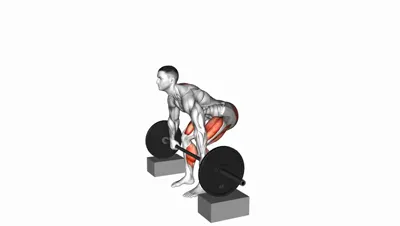
Description
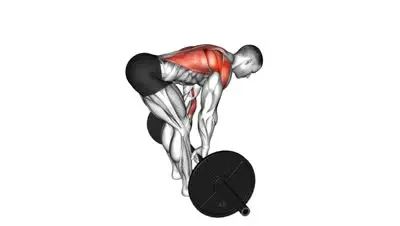
The dumbbell bent over row lets each arm pull independently through its own full range of motion, building back thickness while also correcting side-to-side strength imbalances that a barbell version can mask. Hinging at the hips with a flat back and rowing two dumbbells up toward your ribs trains the lats, rhomboids and rear delts with a slightly greater range of motion than a barbell allows, since dumbbells aren't blocked by your torso at the bottom of the pull. Because each side works independently, it also demands more core and hip-hinge stability than a machine row, making it a strong bridge between pure isolation work and heavy barbell rowing.
How to perform
- Set up with dumbbells in hand Stand holding a dumbbell in each hand, feet roughly hip-width apart, with a slight bend in your knees.
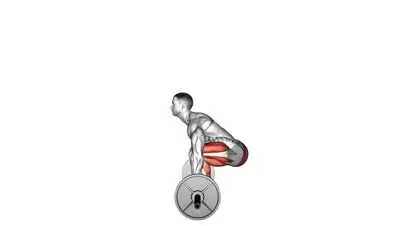
- Hinge at the hips Push your hips back and lean your torso forward until it's roughly parallel to the floor, keeping your spine flat and your chest up.
- Let the dumbbells hang Let your arms hang straight down from your shoulders with the dumbbells just below your knees, palms facing each other or facing back.
- Row both dumbbells up Pull your elbows back and up toward your hips, leading with your elbows rather than your hands, until the dumbbells reach your ribs.
- Squeeze your shoulder blades Pause briefly at the top of the row with your shoulder blades pulled together, feeling the contraction across your entire back.
- Lower under control Lower the dumbbells back to a full stretch under control, keeping your hinge position steady throughout the set.
Tips
- Keep your spine flat and your hips still throughout the set — using your lower back to help heave the weight up turns the row into a deadlift variation.
- Lead with your elbows on every rep, not your hands — thinking about pulling with your elbows keeps the back muscles engaged instead of the biceps.
- Let each arm move independently rather than forcing perfect symmetry — dumbbells allow the stronger and weaker side to each do their own honest work.
- Choose a hinge angle you can hold with a flat spine for the entire set — a deeper hinge increases range but only if your lower back can maintain position.
Common mistakes
- Rounding the lower back under load — this is the highest-risk mistake in any bent-over row and can strain the spine; keep a flat back or stop the set.
- Standing up too tall between reps — losing the hinge angle mid-set shortens the range of motion and shifts the exercise toward a standing shrug.
- Using momentum from the hips to jerk the weight up — this recruits the lower back instead of the target back muscles; keep the hinge fixed and pull with your arms.
- Letting the shoulders round forward at the bottom of each rep — this can strain the shoulder joint over time; keep your shoulder blades set and stable throughout.
Recommended sets & reps
| Sets | Reps | RIR | |
|---|---|---|---|
| Strength | 3–4 | 6–8 | 1–2 |
| Hypertrophy | 2–3 | 8–12 | 1–2 |
| Endurance | 2–3 | 12–15 | 2–3 |
| Power | 3 | 5–8 | 1–2 |
These ranges are working sets only — add 1–2 progressive warm-up sets before each working set. Pair with 2× per week frequency to reach ~10–20 weekly sets per muscle group, the volume range supported by current evidence (Schoenfeld 2017, Pelland 2025).
Benefits
Builds back thickness through a fuller range of motion than a barbell allows, since the dumbbells can travel past the point where a bar would touch your torso. Lets each side of your back work independently, exposing and correcting strength imbalances that a barbell row can hide by letting the stronger side compensate. Demands genuine hip-hinge and core stability throughout the set, building the same postural strength that carries over to deadlifts and other hip-hinge movements. A versatile row variation that bridges the gap between heavy barbell rowing and single-arm isolation work, making it a staple in most well-rounded back-training programs.
Frequently asked questions
Dumbbell bent over row vs barbell bent over row — which is better?
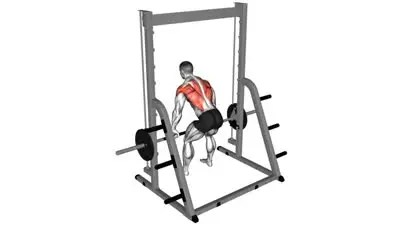
The dumbbell version allows a slightly deeper stretch and lets you correct left-right imbalances since each arm works independently; the barbell version allows heavier total loading. Most complete programs use both across a training cycle.
How far should I hinge forward for this row?
A 45- to 90-degree hip hinge works well depending on your hamstring flexibility and lower-back strength — choose an angle you can hold with a flat spine for the entire set rather than the deepest angle possible.
Why does my lower back get tired before my back muscles on this row?
This usually means your hip-hinge position is too demanding for your current core and lower-back strength. Try a slightly more upright hinge angle or reduce the load until your back is the limiting factor instead of your spine.
Should I row both dumbbells at once or one at a time?
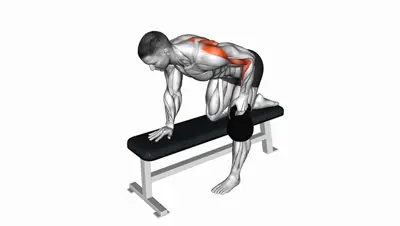
Rowing both together, as described here, trains the back with more total load per set. Rowing one arm at a time (single-arm row) increases range of motion further and adds an anti-rotation core demand — both are valuable variations.
Educational guidance only — not a substitute for in-person coaching. Train within your ability and use a spotter for heavy attempts.