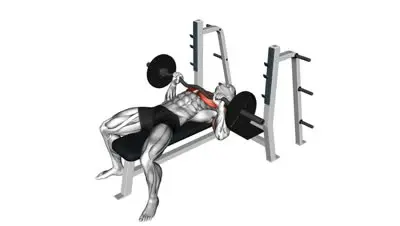
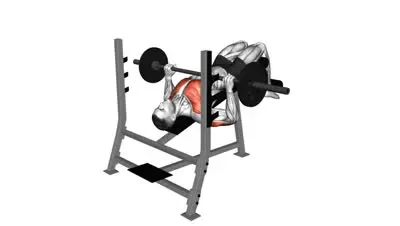
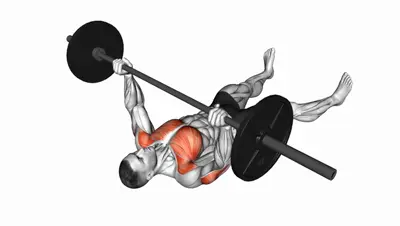
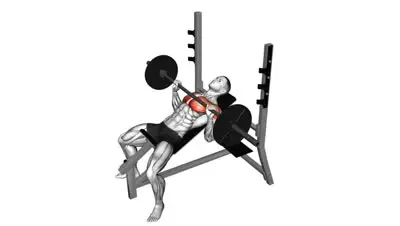
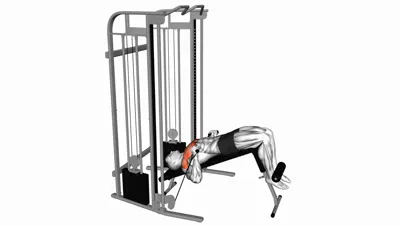
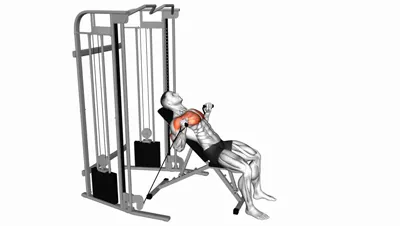
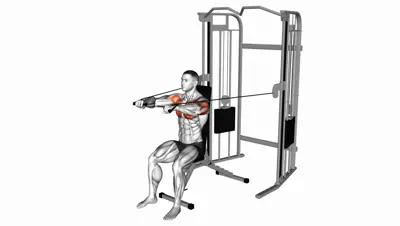
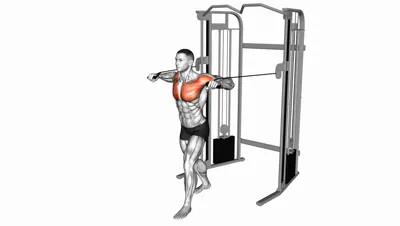
Description
The machine chest press guides the pressing motion along a fixed arc, isolating the pectorals, front delts and triceps without the balance and stabilization demand of a barbell or dumbbell bench press. Sitting upright with back support and pressing two handles forward removes the need to control an unstable loaded bar, letting you push closer to true muscular failure with lower technical risk and a more consistent bar path rep after rep. Because the machine handles balance for you, it's a dependable way to train the chest heavy on days when your shoulders, wrists, or stabilizers are the limiting factor elsewhere in your session.
How to perform
- Set the seat height Adjust the seat so the handles line up with your mid-chest at the starting position, with your back flat against the pad.
- Grip the handles Take hold of both handles with a firm grip, keeping your wrists straight and stacked in line with your forearms.
- Brace your back against the pad Press your back firmly into the pad and plant your feet flat on the floor before you begin pressing.
- Press the handles forward Push the handles forward and slightly together until your arms are extended, without your shoulders rounding forward off the pad.
- Pause without locking out hard Hold for a moment at near-full extension, keeping tension in the chest rather than snapping the elbows into a hard lockout.
- Return under control Bring the handles back to the starting position slowly, feeling a stretch across your chest without your back lifting off the pad.
Tips
- Keep your back pressed firmly against the pad throughout every rep — letting it round forward shifts stress into your shoulders and reduces chest tension.
- Press the handles slightly inward at full extension if the machine allows — this keeps the chest engaged through the lockout rather than shifting to the triceps.
- Don't rush the return phase — controlling the stretch position under tension is a key part of the hypertrophy stimulus from this exercise.
- Adjust the seat height so the handles align with your mid-chest, not your shoulders or your upper abdomen, to keep the emphasis on the pectorals.
Common mistakes
- Letting the shoulders round forward off the pad to press more weight — this shifts stress away from the chest and toward the shoulder joint; keep your back set against the pad.
- Locking the elbows out hard at full extension — snapping into lockout under heavy load adds unnecessary stress to the elbow joint over time.
- Setting the seat too high or too low — a mismatched handle height changes the pressing angle and can shift emphasis away from the chest toward the shoulders.
- Using a weight so heavy the stretch position collapses — losing control on the way back skips the lengthened-tension stimulus that drives chest growth.
Recommended sets & reps
| Sets | Reps | RIR | |
|---|---|---|---|
| Strength | 3–4 | 6–8 | 1–2 |
| Hypertrophy | 2–3 | 8–12 | 1–2 |
| Endurance | 2–3 | 12–15 | 2–3 |
| Power | 3 | 4–6 | 1–2 |
These ranges are working sets only — add 1–2 progressive warm-up sets before each working set. Pair with 2× per week frequency to reach ~10–20 weekly sets per muscle group, the volume range supported by current evidence (Schoenfeld 2017, Pelland 2025).
Benefits
Builds chest size and pressing strength with a guided path that removes the balance and stabilization demand of free-weight bench pressing, letting you focus entirely on the pectorals and triceps. Allows you to safely push closer to true failure since there's no risk of losing control of an unstable barbell or dumbbells overhead of your chest. Provides a consistent, repeatable bar path rep after rep, making it easier to track progressive overload over time compared to free-weight variations. A dependable option for training chest heavy on days when shoulder or wrist stability is the limiting factor in your session.
Frequently asked questions
Machine chest press vs barbell bench press — which builds more chest muscle?
Both produce comparable chest hypertrophy when trained to similar effort, since muscle growth depends primarily on mechanical tension and proximity to failure. The barbell trains more stabilizer and core strength; the machine lets you isolate the chest and push closer to failure more safely.
Is the machine chest press good for beginners?
Yes — the fixed path and back support make it one of the easiest ways to learn a heavy pressing pattern before progressing to free-weight bench pressing that demands more shoulder and core stability.
Why do my shoulders take over on the machine chest press?
This usually happens when the seat height doesn't align the handles with your chest, or when your shoulders round forward off the pad during the press. Adjust the seat and keep your back flat against the pad throughout.
Can machine chest press replace bench press entirely?
It's a strong substitute for accumulating chest volume with less technical risk, but the barbell bench press trains stabilizer strength and total-body bracing that the machine removes — including both across a training week builds the most complete chest and pressing development.
Educational guidance only — not a substitute for in-person coaching. Train within your ability and use a spotter for heavy attempts.