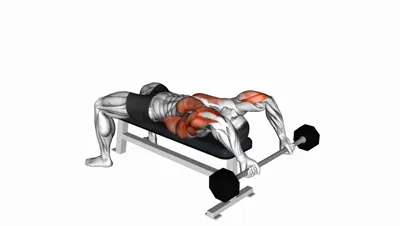
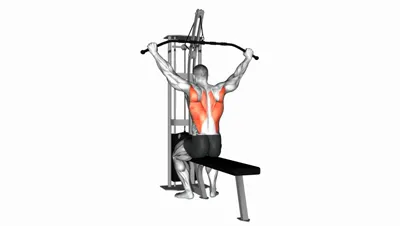
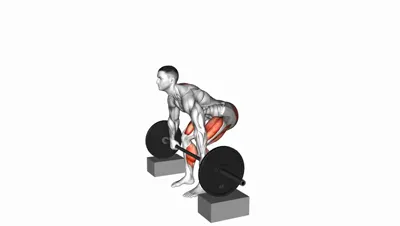
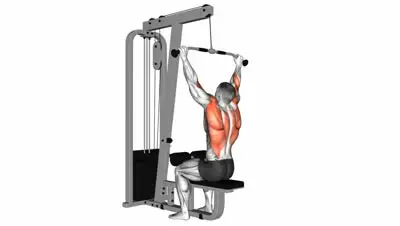
Description
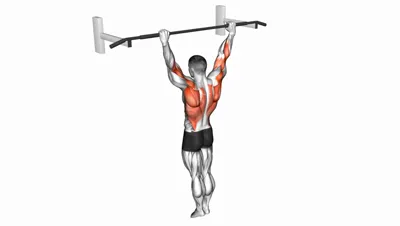
The pull-up is the king of vertical pulling and the purest test of relative upper-body strength. Hanging from a fixed bar and pulling your own bodyweight until your chin clears it, the pull-up loads the lats, teres major, rhomboids and biceps through a full overhead range of motion. Because the load is your own body, it builds the wide, V-taper back and the strength-to-weight ratio that no machine can directly train. It scales endlessly — from band-assisted reps for beginners to weighted reps with a dip belt for advanced lifters — making it a lifelong back builder.
How to perform
- Grip the bar overhand Take a dead hang from a fixed bar with an overhand (pronated) grip slightly wider than shoulder-width. Hang with straight arms and active shoulders — not collapsed up by your ears.
- Set your shoulders and core Pull your shoulder blades down and back to engage the lats before you bend the elbows. Brace your core and squeeze your glutes so the body stays rigid, not swinging.
- Pull your chest to the bar Drive your elbows down and back toward your ribs, leading with the chest. Imagine pulling the bar down to you rather than just lifting your chin.
- Clear the bar at the top Pull until your chin clears the bar and your upper chest approaches it. Squeeze the lats hard at the top without shrugging the shoulders up to your ears.
- Lower to a full hang Lower under control all the way back to a dead hang with straight arms. The lowering phase builds as much muscle as the pull — do not just drop off the bar.
- Stay tight between reps Keep the core braced and avoid kipping or swinging. Reset in a controlled hang at the bottom before the next strict rep.
Tips
- Initiate every rep by depressing the shoulder blades — pulling 'shoulders away from ears' first switches on the lats before the arms take over.
- Drive your elbows down toward your back pockets, not just up — this cue turns a biceps-dominant chin-pull into a lat-driven movement.
- Build strict reps before chasing volume: one clean dead-hang-to-chin rep is worth three half-rep kips for back development.
- Once you pass ~12 strict reps, add load with a dip belt rather than endlessly adding reps — the back responds to progressive overload like any muscle.
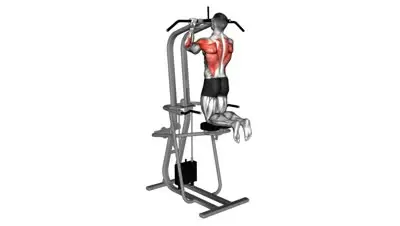
- Use band assistance or a lat pulldown to accumulate volume if you can't yet hit your target rep range with strict form.
Common mistakes
- Half-repping the bottom — stopping short of a full dead hang removes the stretched-position tension that drives lat growth.
- Kipping for strength work — swinging the hips to generate momentum trains coordination, not the back. Save kipping for conditioning, not hypertrophy.
- Leading with the chin — craning the neck over the bar instead of pulling the chest up shifts work to the biceps and strains the neck.
- Shrugging at the top — letting the traps take over at the peak means the lats stop working exactly where the squeeze matters most.
- Neglecting the eccentric — dropping out of the top instead of lowering under control wastes half the muscle-building stimulus.
Recommended sets & reps
| Sets | Reps | RIR | |
|---|---|---|---|
| Strength | 3–5 | 3–6 | 1–2 |
| Hypertrophy | 2–4 | 6–12 | 0–2 |
| Endurance | 2–3 | 12–20 | 1–2 |
| Power | 3–5 | 1–3 | 1–2 |
These ranges are working sets only. As a bodyweight pull, build clean strict reps first — once you exceed ~12 reps, add load with a dip belt instead of chasing endless reps. Pair with 2× per week frequency to reach ~10–20 weekly sets for the back (Schoenfeld 2017, Pelland 2025).
Benefits
Builds the widest, most complete back of any single exercise because pulling your full bodyweight overhead recruits the lats through their entire range. Develops a strength-to-weight ratio that carries over to climbing, gymnastics and every other pulling movement. Strengthens the biceps, forearms and grip as a free side-effect of holding the bar. Trains the core isometrically as it keeps the body rigid against the pull. Requires zero equipment beyond a bar, making it the most accessible heavy back builder in existence — and it scales for decades, from band-assisted reps to heavy weighted singles.
Frequently asked questions
I can't do a single pull-up — how do I start?
Build the movement with band-assisted pull-ups, lat pulldowns and slow negatives (jump to the top, then lower as slowly as possible for 5+ seconds). Train the pattern 2–3× per week and most people earn their first strict rep within a few weeks to a couple of months.
Pull-ups vs chin-ups — what's the difference?
Pull-ups use an overhand (pronated) grip and bias the lats and upper back. Chin-ups use an underhand (supinated) grip, allow more biceps involvement and are usually a little stronger for most people. Both build the back — rotating between them covers all bases.
How do I make pull-ups harder once they're easy?
Add external load with a dip belt or weighted vest, slow down the eccentric, pause at the top, or shorten your rest between sets. Adding weight is the most reliable driver — treat the pull-up like any barbell lift and progressively overload it.
Should I do pull-ups or lat pulldowns?
Do both if you can. Pull-ups build the most relative strength and core stability because you move your own bodyweight; lat pulldowns let you precisely dial load up or down and accumulate volume without grip fatigue. Beginners often start with pulldowns and add pull-ups as strength allows.
Educational guidance only — not a substitute for in-person coaching. Train within your ability and use a spotter for heavy attempts.