Description
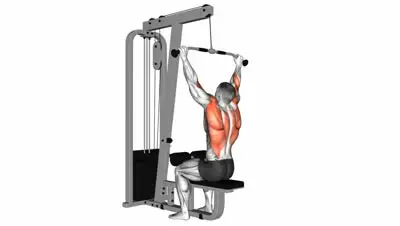
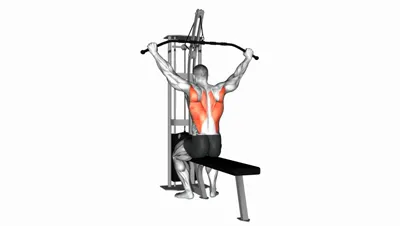
The lat pulldown is the most accessible vertical-pulling machine for building the lats and a wide back. Seated with your thighs anchored under a pad, you pull a cable bar down to your upper chest against a load you can dial in pound by pound — making it the ideal way to train the pull-up pattern with precise, scalable resistance. Because the seat fixes your body, the lat pulldown isolates the back without the bracing demand of a free pull-up, letting beginners build pulling strength and advanced lifters accumulate high-quality back volume under constant cable tension.
How to perform
- Set the pad and grip Adjust the thigh pad so your legs are anchored snugly. Grip the bar with an overhand grip slightly wider than shoulder-width and sit down with your arms fully extended overhead.
- Set your torso angle Sit tall with a slight backward lean of about 10–20° from vertical and your chest up. Keep this torso angle fixed for the whole set rather than rocking back and forth.
- Depress the shoulder blades Before bending the elbows, pull your shoulder blades down and back to engage the lats. This pre-tension keeps the movement lat-driven instead of biceps-dominant.
- Pull to the upper chest Drive your elbows down and slightly back, pulling the bar to your upper chest. Lead with the elbows and imagine driving them toward your back pockets.
- Squeeze at the bottom Pause briefly with the bar near your chest and the lats fully contracted. Keep tension on the muscle rather than letting the bar rest against you.
- Control the way up Let the bar rise under control back to full overhead extension, allowing the lats to stretch without shrugging the shoulders up. Do not let the stack slam between reps.
Tips
- Set a fixed torso angle and own it — rocking back to heave the weight turns the pulldown into a row and removes the vertical-pull stimulus.
- Lead with the elbows, not the hands — thinking 'drive elbows to the floor' recruits the lats far better than pulling with the arms.
- Reach a full overhead stretch at the top each rep — the lengthened position is where machine pulldowns earn their keep over partial reps.
- A medium-wide overhand grip hits the lats best; a closer or neutral grip shifts emphasis toward the lower lats and biceps. Rotate grips over time.
- Slow the eccentric — a controlled 2–3 second return under constant cable tension drives more growth than a fast, stack-slamming rep.
Common mistakes
- Using momentum — leaning way back and swinging the torso to move a heavy stack trains the hips and lower back, not the lats.
- Pulling behind the neck — the behind-the-neck pulldown forces the shoulders into a vulnerable position and offers no advantage. Pull to the upper chest in front.
- Stopping short at the top — cutting the overhead stretch short removes the lengthened-position tension that drives lat growth.
- Letting the biceps take over — pulling with the hands and arms instead of depressing the shoulder blades first turns it into a biceps exercise.
- Going too heavy — a load you can only move by rocking your whole body means the lats never actually do the work. Drop the weight and own the form.
Recommended sets & reps
| Sets | Reps | RIR | |
|---|---|---|---|
| Strength | 3–4 | 6–8 | 1–2 |
| Hypertrophy | 2–3 | 8–12 | 1–2 |
| Endurance | 2–3 | 12–20 | 2–3 |
| Power | 3–4 | 5–6 | 1–2 |
These ranges are working sets only — add 1–2 progressive warm-up sets before each working set. Pair with 2× per week frequency to reach ~10–20 weekly sets per muscle group, the volume range supported by current evidence (Schoenfeld 2017, Pelland 2025).
Benefits
Builds the lats and a wide back with precisely scalable resistance, making it the ideal vertical pull for beginners who can't yet do pull-ups and for advanced lifters accumulating back volume. The fixed seat removes the bracing demand of a free pull-up, letting you focus entirely on contracting the lats under constant cable tension. Lets you dial load in small increments for clean progressive overload week to week. Trains the same vertical-pull pattern as the pull-up, building the strength base that transfers directly to earning and adding reps to bodyweight pulls. Easy to set up and joint-friendly across a wide range of loads.
Frequently asked questions
Lat pulldown vs pull-up — which should I do?
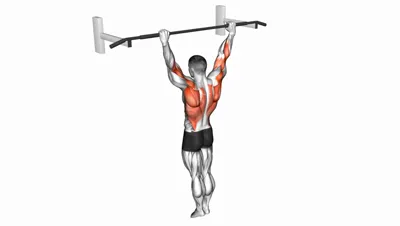
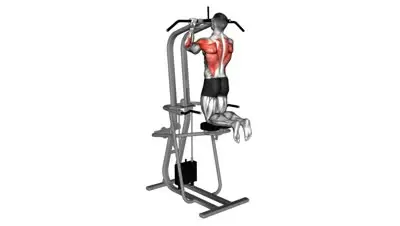
The pull-up builds more relative strength and core stability because you move your own bodyweight, but it's all-or-nothing if you can't yet do reps. The lat pulldown lets you train the same pattern with a load you can dial up or down precisely. Beginners should lean on the pulldown to build strength; most lifters benefit from programming both.
Should I pull the bar in front or behind my neck?
Always in front, to your upper chest. Behind-the-neck pulldowns force the shoulders into external rotation and a forward head position with no added benefit and a higher injury risk. The to-the-chest version trains the lats fully and safely.
Why don't I feel lat pulldowns in my lats?
Usually the biceps are taking over. Depress and retract your shoulder blades before you bend the elbows, lead the pull with your elbows rather than your hands, and slow the eccentric. Dropping the weight slightly so you can feel the back work is almost always the fix.
How wide should my grip be on the lat pulldown?
A medium grip, roughly 1.5× shoulder width with an overhand hold, maximizes lat involvement for most people. A wider grip slightly shortens the range of motion; a closer or neutral grip shifts emphasis toward the lower lats and biceps. Rotating grips over a training block covers the whole back.
Educational guidance only — not a substitute for in-person coaching. Train within your ability and use a spotter for heavy attempts.