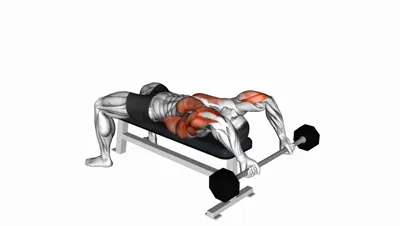
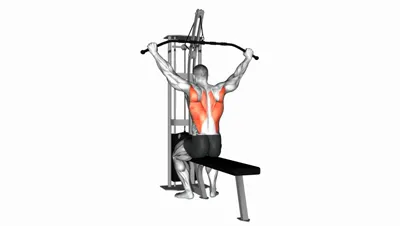
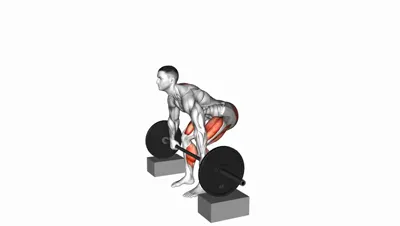
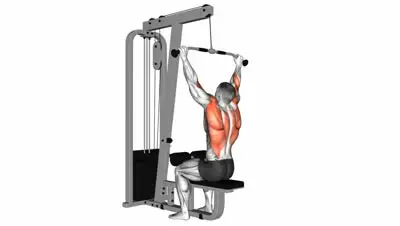
Description
The machine low row is a seated, chest-supported horizontal pull that targets the lats, rhomboids and rear delts through a fixed, low-angle pulling path — handles start low and travel back toward your hip line rather than your upper chest. The chest pad locks your torso in place, removing the lower-back stabilization demand of a barbell row and letting you isolate the pulling muscles at heavier loads with less technical risk. Because the machine controls the bar path, it is one of the most reliable ways to add heavy back volume on days when your grip, lower back or balance are the limiting factor elsewhere in the session.
How to perform
- Set the seat and pad height Adjust the seat so the chest pad sits at your mid-chest and your torso leans slightly forward into it. Set the handle height so your arms start close to fully extended.
- Grip the handles Take a neutral or slightly pronated grip on the handles, whichever the machine offers. Press your chest firmly into the pad before you pull.
- Brace and initiate the pull Pull your shoulder blades down and together first, then drive your elbows back and down toward your hip line — lead with the elbows, not the hands.
- Squeeze at full contraction Bring the handles to your ribs and pause for a moment with your shoulder blades fully retracted, feeling the contraction across your entire back.
- Return to full stretch Extend your arms back out under control until you feel a full stretch through the lats, keeping your chest pinned to the pad the whole time.
- Repeat without losing pad contact Reset your brace and pull again — if your chest lifts off the pad mid-set, the weight is too heavy for strict form.
Tips
- Lead every rep with your elbows traveling down and back — thinking about your hands only turns the row into an arm curl.
- Keep your chest glued to the pad for the entire set; if it lifts off, you've lost the stability advantage the machine is built for.
- Vary your grip width and angle across sessions — the low row's fixed path still lets you bias lats vs mid-back depending on hand position.
- Pause a full second at peak contraction rather than bouncing the weight — the isometric hold is where mid-back thickness comes from.
Common mistakes
- Letting the chest lift off the pad — this turns a stable, isolated pull into a momentum-assisted rep and removes the machine's main safety benefit.
- Pulling with straight arms and shrugged shoulders — this shifts work to the traps and away from the lats; drive the elbows, not the shoulders.
- Using a weight so heavy you can't control the eccentric — slamming the handles back out skips half the growth stimulus and adds unnecessary joint stress.
- Stopping the pull at your stomach instead of your ribs — a short range of motion under-trains the peak-contraction portion of the lift.
Recommended sets & reps
| Sets | Reps | RIR | |
|---|---|---|---|
| Strength | 3–4 | 6–8 | 1–2 |
| Hypertrophy | 2–3 | 8–12 | 1–2 |
| Endurance | 2–3 | 12–15 | 2–3 |
| Power | 3 | 6–8 | 2–3 |
These ranges are working sets only — add 1–2 progressive warm-up sets before each working set. Pair with 2× per week frequency to reach ~10–20 weekly sets per muscle group, the volume range supported by current evidence (Schoenfeld 2017, Pelland 2025).
Benefits
Builds back thickness with a fixed, controlled bar path that removes the balance and lower-back demands of free-weight rows, making it ideal for pushing heavier loads safely. Targets the lats, rhomboids and rear delts through a low pulling angle that complements high-row and lat-pulldown work, filling in the mid-back for a complete pulling program. The chest pad lets you focus entirely on the pulling muscles without spending effort on stabilization, useful for high-volume back days or as a finisher after free-weight rows have fatigued your grip and spinal erectors. A reliable, low-technical-risk way to accumulate horizontal-pull volume week after week.
Frequently asked questions
Machine low row vs machine high row — what's the difference?
Low row pulls handles down toward your hip line and emphasizes the lats and lower back; high row pulls up toward your upper chest and emphasizes the rear delts and upper traps. Most back programs benefit from including both.
Is the machine low row good for beginners?
Yes — the fixed path and chest support make it one of the safest ways to learn a horizontal pulling pattern before progressing to barbell or dumbbell rows that demand more core and lower-back stability.
How heavy should I go on the low row?
Choose a weight that lets you complete every rep with full shoulder blade retraction and control on the way back — if your chest starts lifting off the pad, drop the weight.
Can the low row replace a barbell row entirely?
It's a strong substitute when your lower back is fatigued or if you're new to rowing, but the barbell row trains whole-body bracing that the machine removes — use both across a training week for the most complete back development.
Educational guidance only — not a substitute for in-person coaching. Train within your ability and use a spotter for heavy attempts.