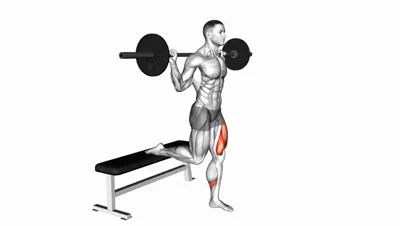
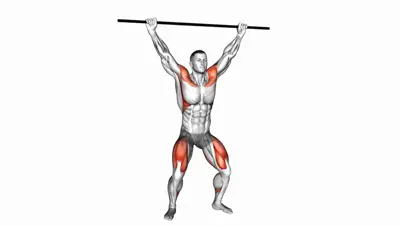
Description
The dumbbell front rack lunge holds two dumbbells at shoulder height in a front-rack position while stepping into a lunge, adding a heavy anterior core-bracing demand on top of the usual quad and glute work of a standard lunge. Racking the weight at your shoulders forces your torso to stay upright against the forward-pulling load, training your core and upper back to resist collapsing forward with every step — a challenge a standard dumbbells-at-your-sides lunge doesn't create. It builds single-leg strength, balance and core stability all at once, making it one of the more complete unilateral leg exercises available with just a pair of dumbbells.
How to perform
- Rack the dumbbells at your shoulders Clean or lift two dumbbells up to your shoulders, resting the ends against your front delts with your elbows pointed forward and down.
- Set your standing posture Stand tall with your core braced and your chest up, keeping the dumbbells stable against your shoulders before you move.
- Step forward into a lunge Take a controlled step forward, lowering your back knee toward the floor while keeping your front shin roughly vertical.
- Keep your torso upright throughout Resist the urge to lean forward as the load pulls at your shoulders — brace your core hard to stay tall through the entire lunge.
- Drive back to standing Push through your front heel to return to a standing position, bringing your feet back together without losing the front-rack position.
- Alternate legs or complete one side first Repeat by stepping forward with the opposite leg, or complete all reps on one leg before switching, depending on your programming.
Tips
- Brace your core hard before every step — the front-rack position constantly pulls your torso forward, and a loose brace will collapse your posture quickly.
- Keep your elbows up and pointed forward throughout the set — dropping elbows lets the dumbbells slide down and pull you into a forward lean.
- Take a controlled step length that lets your front shin stay roughly vertical at the bottom — overstriding shifts more stress to the front knee.
- Start with a lighter load than a standard lunge — the core-bracing demand of the front-rack position makes this variation more demanding at the same weight.
Common mistakes
- Letting the torso lean forward under the front-rack load — this is the most common failure point and shifts stress to the lower back; brace hard and stay tall.
- Letting the front knee cave inward during the step — this places unwanted stress on the knee joint; keep the knee tracking in line with your toes.
- Taking a step too short — an overly short stride limits the range of motion and can push more stress onto the knee instead of the glutes and quads.
- Dropping the elbows and letting the dumbbells slide toward your hands — losing the rack position mid-set reduces core engagement and can strain the wrists.
Recommended sets & reps
| Sets | Reps | RIR | |
|---|---|---|---|
| Strength | 3–4 | 6–8 per leg | 1–2 |
| Hypertrophy | 2–3 | 8–12 per leg | 1–2 |
| Endurance | 2–3 | 12–15 per leg | 2–3 |
| Power | 3 | 5–6 per leg | 1–2 |
These ranges are working sets only — add 1–2 progressive warm-up sets before each working set. Pair with 2× per week frequency to reach ~10–20 weekly sets per muscle group, the volume range supported by current evidence (Schoenfeld 2017, Pelland 2025).
Benefits
Builds single-leg quad and glute strength while simultaneously demanding intense core bracing to resist the forward pull of the front-racked dumbbells, training two major fitness qualities in one movement. Improves balance and coordination through a unilateral stance, exposing and correcting side-to-side strength differences that bilateral squats can mask. Strengthens the upper back and shoulders isometrically as they hold the front-rack position under load, building carryover to front squats and other front-loaded lifts. A time-efficient, equipment-light way to train legs, core and upper-back stability together in a single exercise.
Frequently asked questions
Front rack lunge vs regular dumbbell lunge — what's the difference?
A regular dumbbell lunge holds the weights at your sides, which is easier on the core but doesn't challenge your posture. The front rack position adds a heavy anterior core-bracing demand on top of the usual leg work, making it a more complete but more difficult variation.
Can I do this with kettlebells instead of dumbbells?
Yes — kettlebells work just as well in the front-rack position and some lifters find them slightly more comfortable against the shoulders due to their shape.
Why does my upper back get tired before my legs on this exercise?
Holding two dumbbells at your shoulders under tension is a real isometric challenge for your upper back and core. If this happens consistently, build up your front-rack holding strength separately or reduce the load slightly.
Should I step forward with the same leg each rep or alternate?
Both work well. Alternating legs each rep trains balance and coordination through transitions, while staying on one leg for a full set lets you focus more directly on progressive overload for that specific leg before switching.
Educational guidance only — not a substitute for in-person coaching. Train within your ability and use a spotter for heavy attempts.