Description
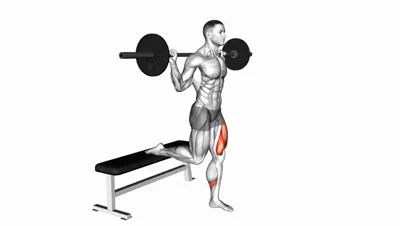
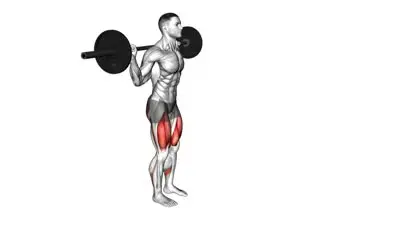
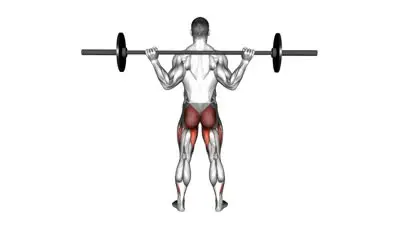
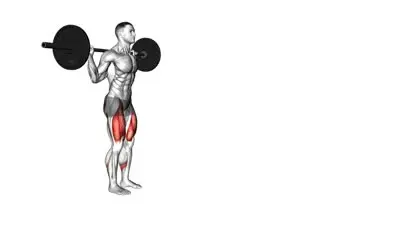
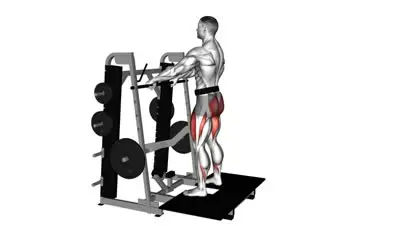
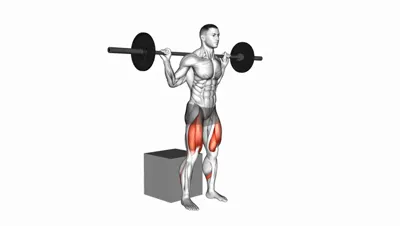
The barbell hack squat is a quad-focused squat variation performed with the barbell held behind the legs, in the deadlift-style grip popularized by old-school strongman George Hackenschmidt. Lifting the bar from behind shifts the load behind your center of mass, forcing a more upright torso and driving the work onto the quads while the glutes assist. Often performed with the heels slightly elevated to deepen knee flexion, the barbell hack squat builds quad mass and knee-extension strength with free weight and minimal lower-back involvement compared with a back squat. It is an advanced movement that rewards good ankle mobility and technique.
How to perform
- Set the bar behind your legs Stand in front of a loaded barbell on the floor with your heels close to it. Set your feet about shoulder-width, toes slightly out, optionally with your heels on a small plate or wedge.
- Hinge down and grip behind you Squat down and reach back to grip the bar behind your legs with an overhand or mixed grip, arms straight. Set your chest up and brace your core hard.
- Stand up to the start Drive through your feet and stand fully upright with the bar hanging behind your thighs at arm's length. This is your starting position for each rep.
- Squat straight down Bend at the knees and hips to lower the bar behind you, keeping the torso as upright as possible and letting the knees travel forward over the toes. Keep your weight mid-foot to heel.
- Reach quad depth Descend until your thighs are at least parallel or your quads are deeply loaded, keeping the bar close behind your legs and your back flat throughout.
- Drive up through the quads Stand back up by extending the knees and hips, keeping the chest tall and the bar tracking close behind you. Lock out upright and re-brace before the next rep.
Tips
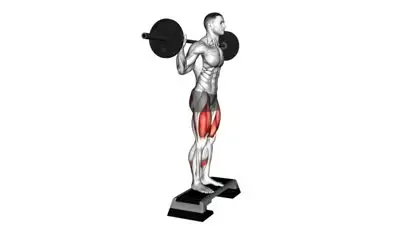
- Elevate your heels on a small plate or wedge — this lets the knees travel forward and turns the lift into a true quad specialist.
- Keep the torso upright and the bar close behind your legs; letting it drift back pulls you off balance and loads the lower back.
- Use straps for working sets — grip behind the body fails long before the quads do, and this is a quad exercise, not a grip test.
- Start light and master the awkward bar path before loading heavy; the behind-the-legs position takes practice to groove.
- Treat it as an accessory to the back or front squat rather than your primary heavy lower-body lift.
Common mistakes
- Letting the bar drift behind you — a bar that swings back shifts load to the lower back and pulls you onto your heels off balance.
- Leaning the torso forward — collapsing the chest turns it into a stiff-leg pull and removes the quad emphasis. Stay upright.
- Skipping heel elevation — squatting flat-footed limits knee travel and reduces the quad stimulus that defines this variation.
- Going too heavy too soon — the unusual bar path makes ego loading dangerous before the pattern is grooved.
- Cutting depth — stopping high robs the quads of the stretched-position tension that drives growth.
Recommended sets & reps
| Sets | Reps | RIR | |
|---|---|---|---|
| Strength | 3–5 | 3–6 | 1–2 |
| Hypertrophy | 2–3 | 6–10 | 1–2 |
| Endurance | 2–3 | 10–12 | 2–3 |
| Power | 3–4 | 3–5 | 1–2 |
These ranges are working sets only — add 2–3 progressive warm-up sets given the technical bar path. Treat the barbell hack squat as a quad accessory, not your primary heavy squat, and pair with other leg work for ~10–20 weekly quad sets (Schoenfeld 2017, Pelland 2025).
Benefits
Builds the quads with free-weight loading and a more upright torso than a back squat, shifting work onto the knee extensors while sparing much of the lower-back stress of a heavy bar on the back. With the heels elevated it drives deep knee flexion and loaded-stretch tension on the quads, a powerful hypertrophy stimulus. As a barbell movement it needs only a bar and plates — no machine — making it a quad specialist available in any gym. It also trains balance, ankle mobility and bracing under an unusual load. Programmed as an accessory to the back or front squat, it adds quad-focused volume that rounds out leg development.
Frequently asked questions
Barbell hack squat vs back squat for quads?
The back squat moves more total load and trains the whole lower body; the barbell hack squat shifts the load behind you for a more upright torso and greater quad emphasis with less lower-back stress. Use the back squat as your primary lift and the barbell hack squat as a quad-focused accessory.
Is the barbell hack squat the same as the machine hack squat?
No. The machine hack squat uses an angled sled with your back supported; the barbell version is a free-weight lift with the bar held behind your legs and no support. The machine is more beginner-friendly and stable; the barbell version demands more balance and technique but needs no machine.
Why do I keep losing balance on the barbell hack squat?
Usually the bar is drifting too far behind you or your heels are flat. Elevate the heels on a small plate, keep the bar close to your legs, and stay upright with a braced core. Start light until the awkward bar path feels natural.
Is the barbell hack squat suitable for beginners?
It is best left until you are comfortable with the back and front squat. The behind-the-legs bar path is awkward and demands good ankle mobility and bracing. Beginners should build their squat first and add the barbell hack squat as an accessory later, or use the machine hack squat instead.
Educational guidance only — not a substitute for in-person coaching. Train within your ability and use a spotter for heavy attempts.