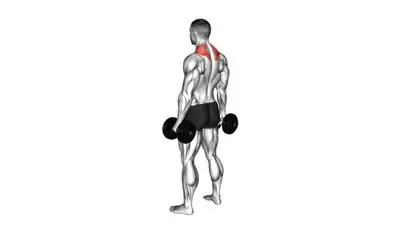
Description
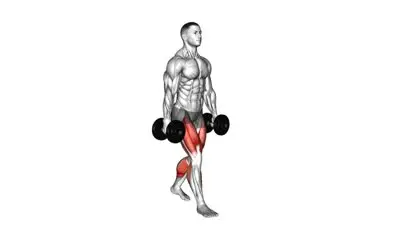
The suitcase carry is a unilateral loaded carry that trains the traps, obliques and forearms to resist lateral flexion while you walk holding a single dumbbell at your side, like a suitcase. Unlike a bilateral farmer's walk, the offset load forces your core to fight sideways bending with every step, building anti-lateral-flexion strength that barbell and machine work rarely touches. It builds a strong upper trap shrug-hold, a vice grip, and a spine that stays upright under asymmetric load — carryover that shows up the moment you pick up a heavy suitcase, a toddler, or a sandbag off the ground.
How to perform
- Pick the dumbbell up safely Stand next to a heavy dumbbell on the floor. Hinge at the hips with a flat back, grip the handle, and drive through your heels to stand up holding it at your side.
- Set your standing posture Stand tall with the dumbbell hanging at arm's length beside your hip. Pull your shoulder blades down and back, brace your core hard, and keep both hips level.
- Resist leaning toward the load Walk forward in a straight line without letting your torso tip toward the loaded side. Keep your ribs stacked over your hips and your free arm relaxed at your side.
- Keep steps short and controlled Take normal, controlled steps rather than long strides — a shorter stride keeps your hips level and stops the load from swinging. Breathe steadily through the carry.
- Set the dumbbell down with control At the end of your set distance, hinge at the hips again and lower the dumbbell to the floor under control instead of dropping it.
- Switch sides and repeat Rest briefly, then repeat the same distance on the opposite side so both halves of your trunk get equal anti-lateral-flexion work across the session.
Tips
- Keep your gaze forward and your chin level — looking down pulls your posture forward and lets the loaded side sag.
- Squeeze the handle as hard as you can maintain — the harder your grip, the more your forearms and traps co-contract to lock the shoulder in place.
- Match total distance or time on both sides in the same session; skipping the weaker side defeats the anti-lateral-flexion purpose of the exercise.
- If your grip fails before your trunk does, alternate hands mid-carry or use lifting straps so the true limiting factor stays the target muscles.
Common mistakes
- Leaning away from the load — tipping your torso to counterbalance the dumbbell removes the core-bracing challenge that makes the carry effective; stay vertical.
- Shrugging the working shoulder up toward the ear — this dumps tension into the neck instead of the traps and forearms; let the shoulder blade stay set down.
- Rushing the pickup and setdown — hinging with a rounded back to grab or drop the dumbbell is where most carry-related back strains happen; hinge with a flat spine.
- Carrying too light for too long — walking pace with a light dumbbell trains cardio more than trap and core strength; the load should challenge your grip within 20–40 m.
Recommended sets & reps
| Sets | Reps | RIR | |
|---|---|---|---|
| Strength | 3–4 | 15–20 m | 0–1 |
| Hypertrophy | 2–3 | 20–30 m | 0–1 |
| Endurance | 2–3 | 30–40 m | 1–2 |
| Power | 3–4 | 10–15 m | 0–1 |
Loaded carries are measured in distance, not reps — push each set until grip or postural control starts to break down (RIR reflects control in reserve, not reps in reserve). Alternate sides every set so both halves of your trunk get equal anti-lateral-flexion volume across the week.
Benefits
Builds a vice-like grip and thick traps just from holding heavy weight upright, since the shrug-hold demand is constant throughout every step. Trains the obliques and deep core stabilizers to resist lateral flexion — a pattern almost no seated or machine exercise trains, making it one of the best tools for a strong, injury-resistant midsection. Strengthens the entire kinetic chain that keeps your spine upright under an asymmetric load, which carries directly into daily tasks like carrying a suitcase, a child, or shopping bags on one side. Because it requires only a single dumbbell and open floor space, it is one of the simplest accessory movements to add to the end of any session for extra grip, trap and core volume.
Frequently asked questions
How far should I carry the dumbbell?
Most lifters do well with 20–40 meters (roughly 20–40 steps) per side as a starting range. If you run out of space, walk back and forth in a straight line, or simply time the carry instead — 20–40 seconds per side works just as well.
What if I don't have enough open floor space?
Walk back and forth along the longest open path in your gym, or carry-in-place by marching on the spot with high knees while holding the dumbbell — the trap and core demand stays the same even without forward travel.
Is one heavy dumbbell better than two lighter ones?
Yes for this exercise specifically — the point of the suitcase carry is the unilateral, offset load. Carrying two dumbbells (a bilateral farmer's walk) removes the anti-lateral-flexion challenge that gives the suitcase carry its unique benefit.
How often should I do suitcase carries?
1–2 times per week as a finisher is plenty — carries are demanding on the grip and nervous system, so treat them as an accessory rather than a primary lift you push to failure every session.
Educational guidance only — not a substitute for in-person coaching. Train within your ability and use a spotter for heavy attempts.