Description
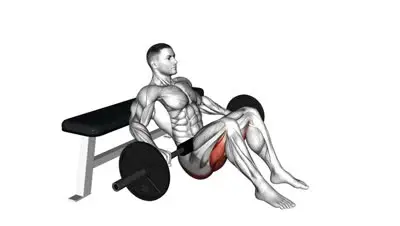
The machine hip thrust locks you into a fixed pad and lever path to load the glutes through the same deep hip-extension range as the barbell version, without the setup hassle of balancing a padded bar across your hips. The machine's guided arc keeps the resistance aligned with your hips throughout the movement, letting you focus purely on driving through your heels and squeezing at the top instead of stabilizing a loaded barbell. Popularized as gyms added dedicated hip-thrust machines, it lets you load the glutes just as heavy as the free-weight version with a faster setup between sets and less strain on your lower back.
How to perform
- Set the machine to your hip height Sit into the machine and position the shoulder or hip pad according to the setup so it lines up directly over your hip crease at the bottom of the range.
- Set your foot position Place your feet flat on the platform at hip-to-shoulder width, close enough that your shins are vertical at the top of the movement.
- Brace before you push Take a breath into your belly, tuck your ribs down, and brace your core — the fixed path removes balance demands but your bracing still controls the rep.
- Drive your hips up Push through your heels and drive your hips straight up until your torso and thighs form a flat line, letting the machine's arm guide the bar path.
- Squeeze hard at the top Pause at full hip extension and squeeze your glutes as hard as you can for a full second without arching your lower back.
- Lower with control and repeat Lower your hips back down under control until you feel a stretch, then drive back up for the next rep without losing tension in your glutes.
Tips
- Keep your chin tucked and your gaze forward throughout the set — extending your neck at the top encourages a lower-back arch instead of a glute squeeze.
- Push through your heels, not your toes — heel-driven force transfers more directly into hip extension and keeps the quads from taking over.
- Use the machine's fast reset between sets to fit in more volume than the barbell version allows in the same training window.
- If your hip flexors cramp before your glutes fatigue, shorten your range slightly at the bottom rather than stopping the set early.
Common mistakes
- Hyperextending the lower back at the top — arching past a flat torso line to squeeze harder shifts stress to the spine instead of the glutes; stop at neutral.
- Letting the knees cave inward on the drive — this pulls tension away from the glutes and toward the inner thighs; push your knees slightly outward.
- Rushing the eccentric — dropping the hips quickly between reps skips the lengthened-position tension that drives glute growth; lower over 2 full seconds.
- Setting the pad too low or too high — a poorly positioned pad changes the resistance curve and can dig painfully into your hips; adjust it before adding load.
Recommended sets & reps
| Sets | Reps | RIR | |
|---|---|---|---|
| Strength | 3–4 | 6–8 | 1–2 |
| Hypertrophy | 2–3 | 8–12 | 1–2 |
| Endurance | 2–3 | 12–20 | 2–3 |
| Power | 3–4 | 3–5 | 1–2 |
These ranges are working sets only — add 1–2 progressive warm-up sets before each working set. Pair with 2× per week frequency to reach ~10–20 weekly sets per muscle group, the volume range supported by current evidence (Schoenfeld 2017, Pelland 2025).
Benefits
Loads the glutes through their strongest range of motion — full hip extension — with a guided bar path that removes the setup time and balance demand of the barbell version. Builds the same posterior-chain strength and glute hypertrophy as the free-weight hip thrust while allowing faster transitions between sets, making it easier to accumulate high training volume in a session. Reduces lower-back strain compared to balancing a loaded barbell across your hips, making it a strong option for lifters managing lower-back sensitivity. As one of the most direct glute-builders available, it is a staple for anyone training for glute hypertrophy, sprint power, or general lower-body strength.
Frequently asked questions
Machine hip thrust vs barbell hip thrust — which builds more muscle?
Both load the glutes through the same range and produce comparable hypertrophy when pushed to similar effort. The machine is faster to set up and easier on the lower back; the barbell version works fine if your gym doesn't have a dedicated machine.
Why do my hip flexors burn more than my glutes?
This usually means you're relying on your quads and hip flexors to initiate the movement instead of driving through your heels. Focus the first inch of the push on squeezing your glutes before your legs take over.
How high should I push my hips?
Stop when your torso and thighs form a flat line from shoulders to knees — pushing further into a back arch adds spinal stress without extra glute benefit.
Can beginners use the hip thrust machine safely?
Yes — the guided path makes it one of the safest ways to learn the hip-hinge-to-extension pattern, since the machine controls balance and the bar path for you while you focus purely on the squeeze.
Educational guidance only — not a substitute for in-person coaching. Train within your ability and use a spotter for heavy attempts.