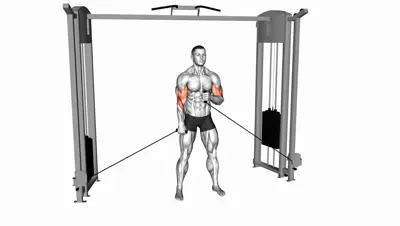
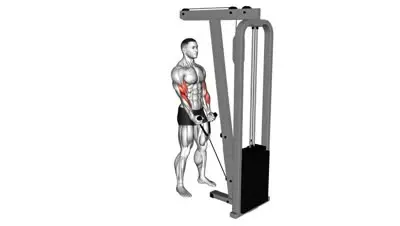
Description
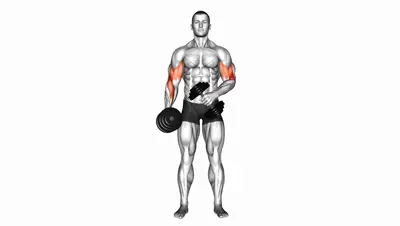
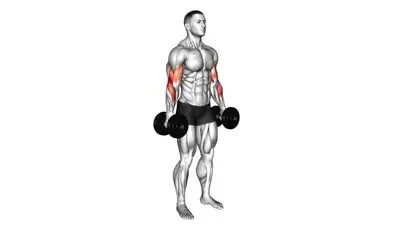
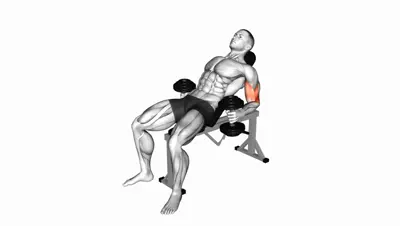
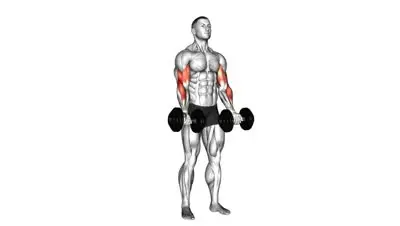
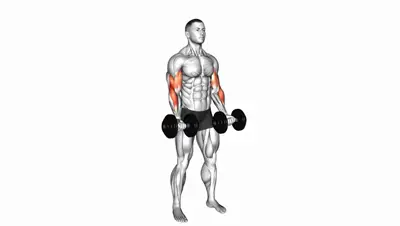
The dumbbell biceps curl is the foundational biceps-building movement, curling a dumbbell in each hand from a fully extended arm up to full elbow flexion through a natural, shoulder-width path. Because each arm moves independently, it lets you rotate your wrist during the lift (supinating) to add a peak-contraction squeeze that a barbell curl doesn't allow, and it exposes any strength imbalance between your dominant and non-dominant arm instead of letting the stronger side compensate. As one of the most universally recognized exercises in strength training, it remains one of the simplest and most effective ways to build biceps size and strength with nothing more than a pair of dumbbells.
How to perform
- Stand holding two dumbbells Stand tall holding a dumbbell in each hand at your sides, palms facing your body, feet roughly shoulder-width apart.
- Pin your elbows to your sides Keep your elbows close to your torso and your upper arms still — they'll stay in roughly the same position for the entire set.
- Curl one or both arms up Flex your elbows and curl the dumbbells up toward your shoulders, optionally rotating your palms to face upward as you lift.
- Squeeze at the top Bring the dumbbells as high as comfortable without your elbows drifting forward, and squeeze your biceps hard for a moment.
- Lower with control Lower the dumbbells back down slowly to a full arm extension, resisting the weight the entire way instead of letting it drop.
- Reset and repeat Pause briefly at the bottom with your arms fully extended before starting the next rep, keeping your elbows pinned throughout.
Tips
- Keep your elbows glued to your sides throughout the set — letting them drift forward turns the curl into a partial front raise and reduces biceps tension.
- Rotate your palms to face upward as you curl for an added peak-contraction squeeze, especially valuable if you tend to start with a neutral or pronated grip.
- Curl both arms together for symmetry and time-efficiency, or alternate arms to focus more mental attention on each side individually.
- Control the lowering phase just as carefully as the lift — most of the muscle-building stimulus from a curl comes from resisting the weight on the way down.
Common mistakes
- Swinging the torso to help lift the weight — using body momentum instead of strict elbow flexion removes tension from the biceps and adds unnecessary lower-back stress.
- Letting the elbows drift forward or backward mid-set — this changes the exercise into a shoulder-assisted movement and reduces the pure biceps isolation.
- Curling with a weight too heavy to control on the way down — dropping the dumbbells quickly skips the eccentric tension that drives biceps growth.
- Locking out the wrists in an overly bent or overly straight position — an unnatural wrist angle under load can create unnecessary forearm or elbow strain over time.
Recommended sets & reps
| Sets | Reps | RIR | |
|---|---|---|---|
| Strength | 3–4 | 6–8 | 1–2 |
| Hypertrophy | 3–4 | 8–12 | 1–2 |
| Endurance | 2–3 | 12–15 | 2–3 |
| Power | 3 | 6–8 | 2–3 |
These ranges are working sets only — add 1–2 progressive warm-up sets before each working set. Pair with 2× per week frequency to reach ~10–20 weekly sets per muscle group, the volume range supported by current evidence (Schoenfeld 2017, Pelland 2025).
Benefits
Builds biceps size and strength through a natural, shoulder-width path that most lifters can perform with excellent technique from the very first session, making it one of the most accessible upper-arm exercises available. Lets each arm work independently, correcting any strength imbalance between your dominant and non-dominant side that a barbell curl might otherwise hide. The optional wrist rotation into supination adds a peak-contraction squeeze that increases biceps recruitment beyond what a fixed-grip barbell curl offers. A staple accessory movement that pairs naturally with any pressing or pulling program to round out complete upper-body development.
Frequently asked questions
Should I curl both arms at once or alternate?
Both approaches work well. Curling together is more time-efficient and lets you use momentum-free symmetry as a form check; alternating lets you focus mental attention on each rep individually and often allows slightly better peak contraction per arm.
Why does one arm feel weaker than the other during dumbbell curls?
This is common and exactly why the dumbbell version is valuable — a strength imbalance between arms is normal, and independent dumbbell work lets the weaker arm catch up over time instead of relying on the stronger side to compensate.
Should I rotate my wrist during the curl?
Rotating your palm to face upward as you curl (supination) adds a peak-contraction squeeze and is a common technique variation, but a neutral grip throughout is also effective — try both and use whichever feels stronger through the full range.
How heavy should my dumbbells be for biceps curls?
Choose a weight that lets you complete your target rep range with strict elbow flexion and no torso swing — if you need to lean back or swing to finish the last reps, the weight is too heavy for your current strength.
Educational guidance only — not a substitute for in-person coaching. Train within your ability and use a spotter for heavy attempts.